Chime Banking: What Years of User Feedback Reveal About Convenience vs. Reliability
The appeal of Chime in a banking system users are actively trying to escape
Chime’s growth makes more sense when you look at what users keep complaining about with traditional banks: overdraft fees, slow payroll access, and limited mobile control.Traditional institutions have long been associated with overdraft fees, delayed payroll access, and rigid branch-based systems. Against that backdrop, searches for chime, chime online, and the chime website ecosystem continue to grow as users look for zero-fee alternatives that feel more aligned with mobile-first lifestyles.
Chime Inc. positions itself as a financial technology company rather than a bank. Customer funds are held through partner banks—primarily The Bancorp Bank, N.A. and Stride Bank, N.A. (Members FDIC). This setup is common in fintech, but users often don’t realize how it changes support. In practice, you’re talking to Chime first, not the actual bank holding your money.
That distinction becomes especially relevant in disputes, account restrictions, or transaction investigations, where support often routes through Chime’s digital layer before escalating to the underlying bank.
Onboarding feels effortless—sometimes almost too effortless
Opening a Chime account typically takes only a few minutes through the chime web or mobile app. Users can activate a Chime Visa debit card, connect direct deposit, and begin transactions quickly. This is one reason Chime spreads fast—people can open an account in minutes and start using it almost immediately.

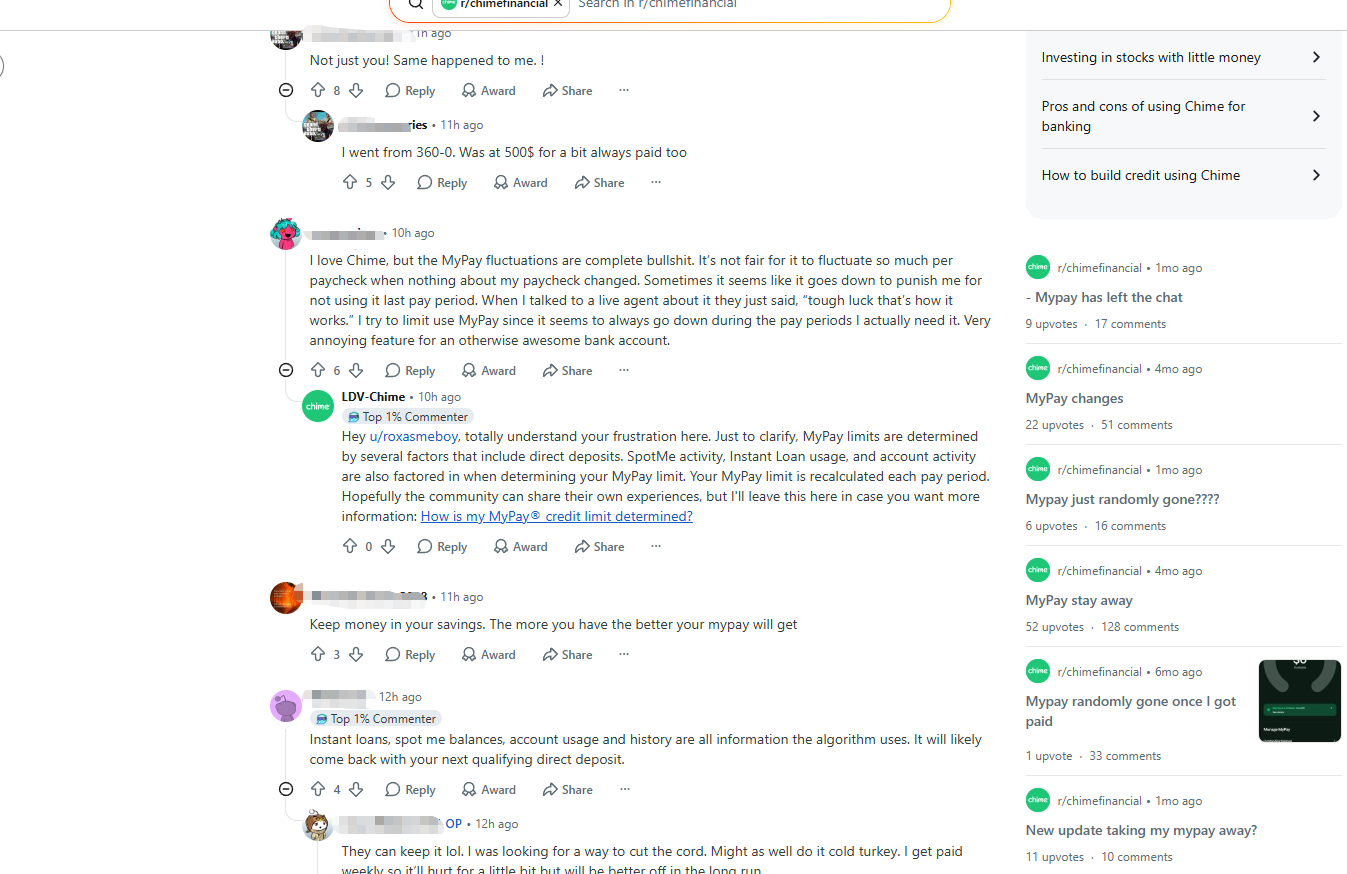
But in user discussions, especially on chime reddit threads, this simplicity is also interpreted in two different ways. Some users on r/chime describe it as “finally not dealing with a bank branch again,” while others are more cautious and question how deep the verification really goes.
Once inside the system, the experience is generally stable for core functions like payments and deposits. However, long-term user sentiment shows a more uneven picture when it comes to interface reliability and feature consistency.
Some users reported that during certain chime promo campaigns, a full-screen banner or overlay appeared and made it hard to tap into the account dashboard or even reach the login button.
Core features: useful, but not always consistent in execution
Chime’s product suite revolves around three primary features: SpotMe overdraft protection, early direct deposit, and the Credit Builder secured card.
SpotMe allows eligible users to overdraft up to $200 without fees. Among community feedback, this is one of the most consistently praised features, particularly for users living paycheck to paycheck. IIt removes the situation where a $10 mistake turns into a $35 overdraft fee overnight, which often carry fixed fees regardless of amount.
Early direct deposit is advertised as enabling access to paychecks up to two days early. In practice, this depends heavily on employer payroll processing timelines. Some users consistently receive early deposits, while others report standard timing. The feature works as designed, In reality, it depends on the employer’s payroll system. Some users consistently see money two days early, others don’t see any difference at all.
The Credit Builder product allows users to build credit through a secured structure without a traditional hard inquiry. However, users must allocate funds to secure the line, which is sometimes underemphasized in marketing discussions. For many users, this tradeoff is acceptable; for others, it effectively locks liquidity into credit building behavior.
One of the most discussed product changes occurred in 2025 when Chime removed the “running balance” feature from transaction histories. Previously, users could track balance changes after every transaction. After that change, users could still see transactions, but they lost the ability to scroll through their balance history and see how each purchase affected their account step by step.
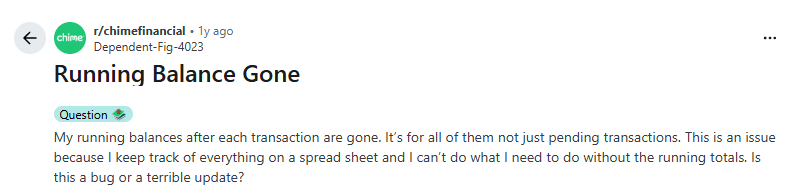
On Reddit and Trustpilot discussions, this change was widely criticized by users who relied on the feature for budgeting and real-time spending awareness. The official framing described it as interface simplification, but many interpreted it as a loss of financial transparency.
The cost advantage is real—but access is not perfectly uniform
Chime advertises access to a large surcharge-free ATM network spanning tens of thousands of locations. In cities, this usually works fine—people can pull cash from Walgreens or CVS without thinking about it.
However, users searching for chime near me in rural or travel contexts often encounter out-of-network ATMs, which can result in third-party fees. The network is extensive, but not evenly distributed.
Referral incentives and promotional structures also introduce constraints. Chime promotions typically require qualifying direct deposits within a strict timeframe, often around 45 days. Missing these conditions means forfeiting bonuses, which has generated frustration among users who interpret marketing language as more flexible than the actual terms allow.
The routing infrastructure, including identifiers such as 103100195, occasionally appears in user discussions when setting up direct deposit. While technically routine in banking systems, these details contribute to confusion for users unfamiliar with fintech banking layers.
Reliability: where user sentiment splits most clearly
Long-term user feedback shows a divided experience pattern. Many users report stable, multi-year usage with minimal issues, particularly for basic spending and direct deposit functions. Others describe intermittent problems such as delayed balance updates, notification lag, or occasional app crashes.
There is also a smaller but significant group reporting more serious issues, including account holds or difficulties resolving disputes. These cases are not the majority, but they carry disproportionate weight in user perception because they affect access to funds directly.
What users describe instead is simple: most of the time everything works, but when something goes wrong, it can take longer than expected to get it fixed. For everyday transactions, performance is generally stable. For exceptions, resolution quality varies more widely than users expect from a financial platform.
Customer support remains the most consistently criticized component
Chime operates primarily through in-app chat support, without physical branches or traditional phone banking for most users. It saves Chime money, but users end up depending on chat support when they’re trying to fix real money problems.
For simple tasks such as card replacement or balance inquiries, support is typically sufficient. However, for fraud disputes or account restrictions, users often report longer resolution times and difficulty escalating beyond initial support tiers.
This is where comparisons with traditional banks become most visible. Legacy institutions offer layered escalation paths including phone and in-branch support. Chime’s model prioritizes scalability over direct human access, which works well until cases become complex.
A grounded view of where Chime fits in the financial ecosystem
Chime performs strongly in areas where simplicity and fee elimination matter most. SpotMe, fee-free banking, and fast onboarding are genuine advantages that explain its widespread adoption.
However, its limitations become more visible when users require predictable edge-case handling, robust dispute resolution, or consistent real-time balance tracking. Feature removals such as the running balance view and occasional interface disruptions during promotional periods reinforce the perception that product priorities sometimes lean toward growth and engagement over financial tooling depth.
Chime works best as a primary account for users with straightforward financial behavior or as a secondary account for those who prefer redundancy in banking systems. For users with more complex financial needs, it often functions better as a complement to traditional banking rather than a full replacement.
Most users don’t think much about Chime until something breaks, then the experience suddenly feels a lot less smooth than it did before.Chime reduces friction in everyday banking while accepting variability in support depth and feature stability. For many users, that trade-off is acceptable. For others, it defines the platform’s ceiling.